Bono and Kennedy killed in tragic accidents
by Jennifer Wrublewski of the Patriot Press
Circulation Manager
On New Year's Eve, the Kennedy family suffered yet another senseless tragedy. Michael Kennedy, son of the late Senator Robert Kennedy, crashed into a tree and died while skiing in Aspen, Colorado.
It was a family ritual to play "ski football," a risky game like touch football and ultimate frisbee combined on a mountainside. Ski football players have to react quickly and cautiously while skiing without poles.
Michael was skiing halfway down the mountain when disaster struck. He turned his head and caught the ball, exclaiming, "this is great," as he hit a fir tree head on. His sister Rory tried to help him as his three young children watched crying.
The Kennedys were all reported to be good skiers, and Michael was considered one of the best. No one foresaw any danger although the slopes in the late afternoon were slick, and icy patches were hard to see.
Weeks after the Kennedy tragedy, Americans were saddened by another senseless accidental ski death. Sonny Bono, the rock and roller turned Republican representative, skied into a tree in the mountains above Lake Tahoe.
Sonny's famed ex-wife Cher flew to the United States from Europe right away when news of the accident spread. She told the public in tears: "This is the most important thing I've ever done in my life," as she took to the pulpit for Sonny's eulogy.
Cher thanked Sonny in her speech and said he was one of the best people that she knew. Sonny's political friends and associates spoke of him as a man to be respected and looked up to.
Sonny was getting extra ski-time alone when the accident occurred. His wife and children were waiting for him to return and had no idea that he wouldn't.
Like Kennedy, Bono was a good skier. He was worried often about safety while skiing. His wife said that just before his death they had been discussing buying new helmets for their next ski trip because they had just learned of Kennedy's death and thought they should be more cautious.
Americans suffered two great losses with the shocking accidental deaths of Bono and Kennedy. The saddest part is that with the use of inexpensive helmets and other safety gear, both tragedies could have possibly been prevented.
 |
 |
Despite Recent Deaths, Snow Skiing is Relatively Safe, Experts
Say
By Susan Schmidt and Curt Suplee
Washington
Post Staff Writers
The deaths of Michael Kennedy and Sonny Bono were in many
respects typical of mortal skiing accidents: The victims were both confident
skiers doing risky things on slopes not considered particularly dangerous.
'The deaths of Kennedy on Dec. 31 at Aspen, Colo., and of Rep.
Bono (R-Calif) on Monday at Lake Tahoe, Calif, generated a surge of public
concern over safety on the slopes. But experts said yesterday that, overall,
snow skiing is a relatively safe sport and is probably less hazardous now than
25 years ago.
"Most serious injuries happen to experienced skiers while
they're skiing on easier terrain than they are used to," said Jeffrey Hadley, an
injury epidemiologist at Johns Hopkins University Those skiers are often
overconfident, going at high speeds and not concentrating as intensely as they
would on more difficult slopes, said Hadley, a former ski instructor.
In addition, both celebrities died in the late afternoon, which
in the view of experts is a critical time.
"A lot of these injuries happen later in the day," said
physician and epidemiologist Julie Gilchrist of the federal National Center for
Injury Prevention in Atlanta. "It's safe to quit before you get exhausted."
However, skiing and snowboarding contribute to few fatalities
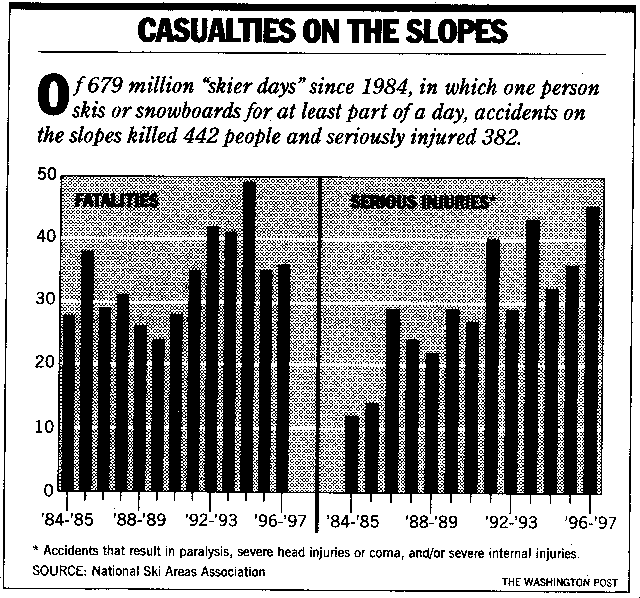
in the United States. On average since 1984, skiers have made slightly more than
50 million visits annually to U.S. ski slopes and an average of 34 people have
died each year, according to data compiled by the National Ski Areas
Association, a trade group representing 330 resorts that account for 90 percent
of America's skier visits.
By comparison, approximately 800 Americans are killed every
year in bicycle accidents and more than 700 in recreational boating
accidents.
As for serious but nonfatal ski injuries, "I don't see any
evidence that they have increased" since 1970, said Jasper Shealy, head of the
industrial and manufacturing engineering department at the Rochester Institute
of Technology.
Shealy, whose specialty is the study of how accidents occur,
has reviewed ski injuries extensively for more than 25 years. The typical
profile of a fatal accident, he said, is one involving a male, in his teens to
mid-thirties. Males are involved in 85 percent of all ski deaths.
"It's generally an intermediate to expert skier," he said, on
an intermediate slope, usually "out at the edge of the trail going from 25 to 40
miles per hour." Typically, the skier loses control and "when you slam into a
tree at that speed, there's not much hope for you," Shealy said, "and a helmet
probably wouldn't help."
Head and spinal injuries of the sort reportedly suffered by
Kennedy and Bono make up the largest category of serious injuries, according to
the data from the National Ski Areas Association. 'These account for about
one-third of the 35 to 45 catastrophic but nonfatal injuries at U.S. ski resorts
every year. The association defines a serious injury as one that results in
paralysis, severe head injuries or coma, or severe internal injuries.
The Kennedy and Bono deaths, Shealy said, were most likely a
"random coincidence" and do not represent any kind of a trend. Gilchrist agreed.
"Over the last few years," she said, "skiing has been safer."
According to the National Injury In formation Clearinghouse,
part of the federal Consumer Product Safety Commission, an estimated 120,000 to
130,000 injuries of all kinds result each year from snow skiing, ranging from a
recent high of 141,302 in 1994 to 108,385 in 1996, the last year for which data
are available.
The American Journal of Sports Medicine published a study in
1994 of ski injuries over a 22 years at Vermont's Sugarbush Mountain. The 8,023
serious injuries included many more lower-leg injuries in the early years and
many more serious knee injuries in the latter part of the study period. The
incidence of upper body injuries remained constant.
Shealy of Rochester, one of the study's authors, said yesterday
that this year an estimated 15,000 to 20,000 skiers will suffer knee injuries,
at a total cost of $400 million in medical bills.
Shealy and co-authors Robert Johnson and Carl Ettlinger of Vermont attributed
the decline in fractures and lower leg injuries to design improvements in ski
boots and bindings. Ettlinger said yesterday that updated equipment has changed
the way people ski, and some times that means they head downhill with more
speed, but less experience.
According to the National Ski Areas Association data, nationwide fatalities
increased about 3 percent during the 1996-97 season compared to the previous
year. In the 1996-97 season, 36 skiers or snowboarders died, the trade group
reported recently, for a death rate about 0.69 per million skier days. In
previous season, 35 died.
But the highest recent death rate recorded in 1994-95, when 49 persons died
for a rate of 0.93 per million days. Since 1979, according to figures, the total
number of skier days has averaged slightly above 50 year. Over the past 13
years, the annual number of fatalities has ranged from 24 to 49, and the rate
from 0.48 death million skier days to 0.93.
"There are risks inherent in the sport," said Julia Carlisle, a spokeswoman
for Killington in Vermont, the biggest ski area in the East "In fact, that's why
people participate--to get a little thrill."